

When Regulations Aren't Enough: The Hidden Gap in Switchgear Safety
5 min read · Electrical & Utilities
Every manufacturer's switchgear is unique. Yet training rarely is. Here's why that mismatch keeps causing incidents — and what a visual SOP approach can do about it.
Low and Medium-Voltage switchgear sits at the heart of some of the most tightly controlled environments in industry. Manufacturer obligations, IEC standards, BS EN regulations, health and safety legislation — the compliance framework is dense, thorough and constantly evolving. And yet, incidents still happen. Too often. Too predictably.
If the regulatory environment is so comprehensive, why does the risk remain so stubbornly high? The answer isn't in the rulebook. It's in the gap between general training and the specific, hands-on reality of operating a piece of equipment an engineer has never touched before.
The Problem With "General" Training
Senior Approved Person (SAP) and Authorised Person (AP) training programmes are foundational. They provide qualified engineers with a robust understanding of safe working practices, isolation procedures, and the legal framework that governs their work. That foundation is essential — no one would argue otherwise.
No AP training course can account for the precise layout of a Schneider Electric MV panel versus an ABB UniGear versus a Siemens NXPLUS. Every manufacturer designs their equipment differently. Cabinet layouts vary. Interlock mechanisms differ. The physical sequence of safe operation — which handle moves first, what visual confirmation is required at each step, where the earthing point is located — is unique to that product, that variant, often that generation.
"The risk isn't in what engineers don't know. It's in what they assume they know — based on experience with something similar."
An experienced engineer, working on unfamiliar equipment, makes a reasonable inference: "This must operate like the units I've switched before." That inference is often correct. But when it isn't, the consequences can be catastrophic.
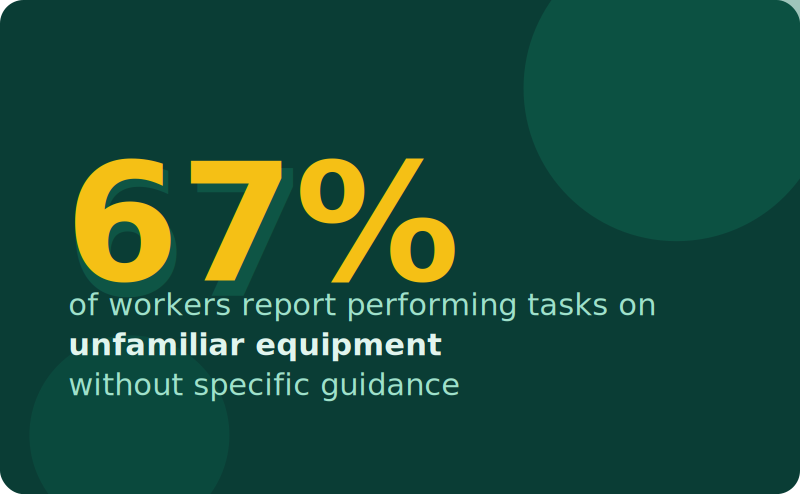
The Statistics Tell Their Own Story


The rules exist. The training exists. The knowledge gap — between what a qualified engineer knows in general and what they need to know at that moment, on that panel — is where the risk lives.
Fear of the Unknown Is a Safety Issue
There's a human dimension to this that often goes unspoken in technical safety literature. Switching unfamiliar equipment doesn't just carry operational risk — it carries psychological pressure. An engineer standing in front of a manufacturer's panel they've never operated before is managing two problems at once: following the correct procedure, and managing the anxiety of not being entirely sure they're in the right place at the right step.
The Confidence Deficit
When operators lack specific knowledge of a piece of equipment, they fall back on analogy — mentally mapping the new panel onto equipment they know. This cognitive shortcut works most of the time. The times it doesn't are precisely when incidents occur. Confidence grounded in accurate knowledge is a safety asset. Confidence built on assumption is a liability.
Building genuine confidence before an engineer encounters unfamiliar switchgear for the first time — in a live environment — is one of the most effective risk-reduction strategies available. It's also one of the most overlooked.
Where Visual SOPs Change the Equation
This is where tools like Knowby make a tangible difference. Rather than relying on generic switching schedules, paper-based manuals, or the assumption that AP training covers everything, Knowby enables organisations to create clear, manufacturer-specific, step-by-step visual Standard Operating Procedures that are as unique as the equipment they describe.
The key word is visual. For physical, hands-on tasks like switchgear operation, a photograph of the actual panel with the correct handle or position annotated is worth considerably more than a paragraph of text. A looped video clip showing the precise movement required at step 4 eliminates ambiguity entirely. Confirmation points built into each step ensure nothing is assumed — everything is verified.
- SOPs built around photos and short video of the actual equipment, not generic diagrams
- Step-by-step sequences that mirror the manufacturer's specific operating logic
- Built-in confirmation checkpoints before advancing to the next action
- Hazard callouts and PPE reminders embedded at the relevant step — not buried in a preamble
- Accessible via QR code on the panel itself — available at the point of work, not back at the office
Critically, Knowby was designed so that creating these SOPs doesn't require a documentation specialist or hours of formatting. A subject matter expert — a maintenance engineer, a commissioning technician, the person who knows that panel inside out — can capture their knowledge rapidly, in a format that anyone can follow.
Here's a great example of a SOP to Open, Isolate, Out of Service & Earth -SPE Energy- BVP 17 (Retrofit created by Lowen Glas Ltd using Knowby:
Building on Foundation Knowledge, Not Replacing It
It's worth being clear about what this approach is not. Manufacturer-specific visual SOPs don't replace AP training. They extend it. They take the solid foundation of qualified electrical knowledge and give it the specific, contextual detail it needs to operate confidently and safely on a particular piece of equipment.
The engineer arrives qualified. The SOP makes them ready — ready for this panel, in this substation, manufactured by this company. The fear of the unknown is replaced by structured, verified knowledge. The assumption — "I think this is how it works" — is replaced by certainty: "I know exactly what happens at each step, because I've walked through it before I got here."
"Regulation sets the floor. Specific, visual SOPs raise the ceiling — and close the gap where incidents actually happen."
The Practical Path Forward
For electrical contractors, DNOs, facilities managers and anyone responsible for switchgear operations, the question isn't whether manufacturer-specific SOPs are valuable — the evidence is clear that they are. The question is whether creating them is practical at scale.
Knowby was built to answer that question. SOPs that previously took days to create and ended up as static PDFs nobody read can now be captured in hours, distributed instantly via QR code, and updated in real time when equipment is serviced or modified. The knowledge that currently lives in the heads of your most experienced engineers becomes institutional knowledge — accessible, scalable and safe.
Incidents in switchgear operations are not inevitable. They are the predictable outcome of a knowledge gap that, with the right tools, is entirely closeable.
See How Knowby Works for Electrical Operations
Create your first manufacturer-specific switchgear SOP in under an hour. No documentation experience required.

Comments